You insert quality modules into a familiar production line, then discover that the belt is full while the next assembler is waiting. The new items look better. Why are they not helping?
In a quality-enabled Factorio game, quality is part of an item’s identity. A higher tier is not a universal substitute for the ingredients a machine requested. Your first quality project should therefore include an output plan, not just a module upgrade.
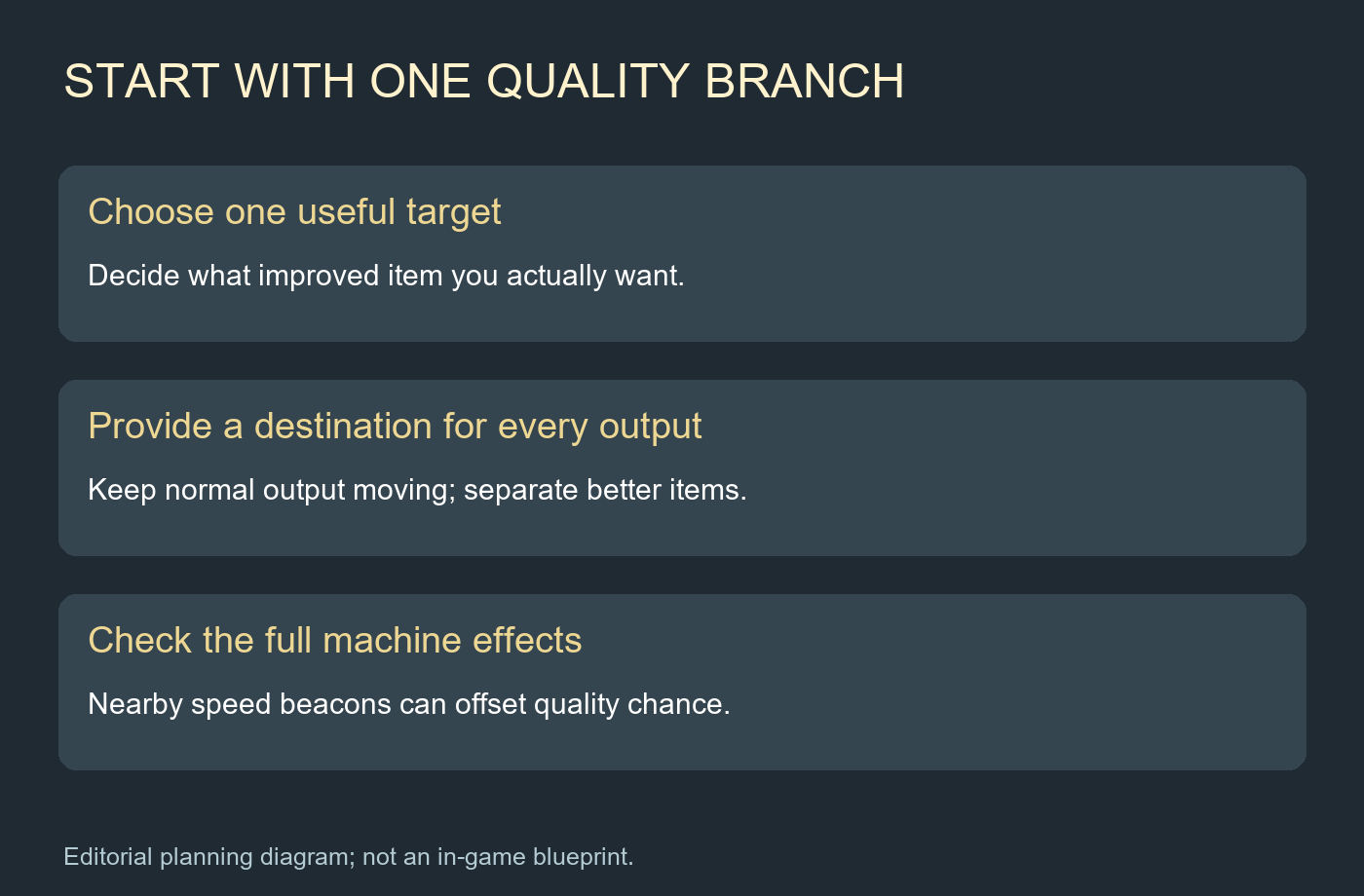
Choose one target before modifying the main factory
Start with something you want in a limited quantity: a better machine for a constrained production area, or a piece of personal equipment. Inspect its tooltip to see which property improves. A higher quality label does not mean every property becomes better in the same way.
Leave the factory’s essential supply line intact while you learn. Wube’s explanation of the system makes a useful distinction: quality is optional, and players can still build with ordinary items. There is no requirement to replace an entire working base before benefiting from a small upgrade.
Keep ingredient tiers separate
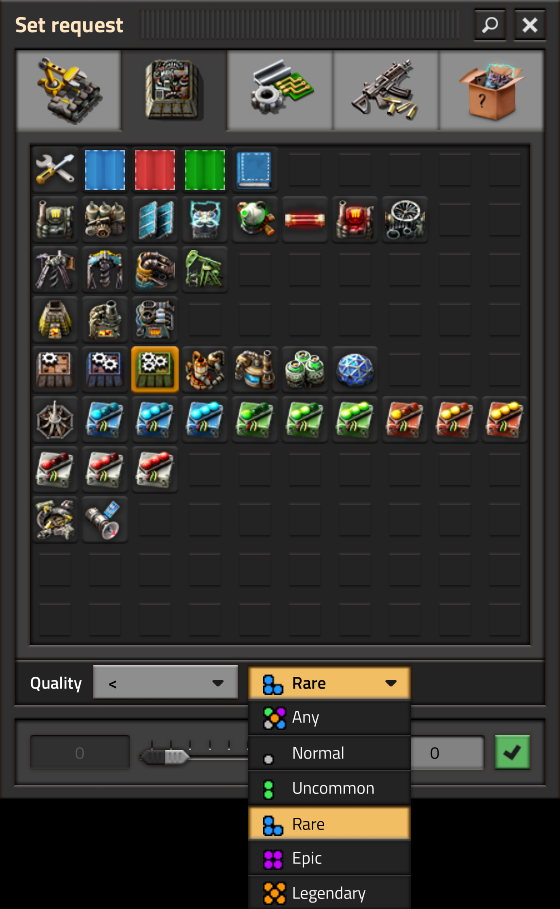
The official quality reference explains that item ingredients must match the selected recipe’s quality exactly. Fluids are exempt because they have no quality. A mixed collection of better components is therefore not necessarily a usable recipe.
For example, suppose your intended product needs several different solid ingredients. Collecting uncommon versions of all but one does not let a rare version fill the last slot. Before blaming the inserter, compare the recipe’s quality selection with each ingredient actually arriving.
Give every possible output a destination. Normal items can continue to an appropriate normal-quality consumer; the better items need a separate, bounded destination until you have a use for them. Check that both routes remain available. A full chest can stop the experiment even when the crafting machine itself is configured correctly.
Inspect nearby speed effects before adding more modules
Speed modules carry a quality penalty. That penalty offsets quality-module effects rather than making products worse than their input quality. Looking only at the slots inside one assembler can miss the contribution of nearby beacons.
Read the machine’s combined effects, then change one thing at a time. A useful first diagnostic is to compare the displayed quality chance with and without the speed influence. This does not mean speed is always a bad choice: faster crafting can change total output over time. It means the percentage and the production rate are separate numbers, and you need both before calling the setup an improvement.
Set a stopping point for the experiment
Decide how many target items you need and limit the branch accordingly. Once that goal is met, install or store the result before expanding. Avoid treating a few lucky higher-tier outputs as proof of a reliable hourly rate; random results need more observation than a single batch.
If the normal factory keeps working, the better ingredients remain sorted, and the target item solves a specific problem, the first project has done its job. A compact, understandable branch is a stronger starting point than scattered modules whose outputs have nowhere to go.